
AI Knowledge Base Transition
The engagement survey said the knowledge base was broken. The data told us why. The solution required more than a new platform, it required teaching an organization to trust AI.
3-Month Transition | 100% Adoption | Live Since November 2024
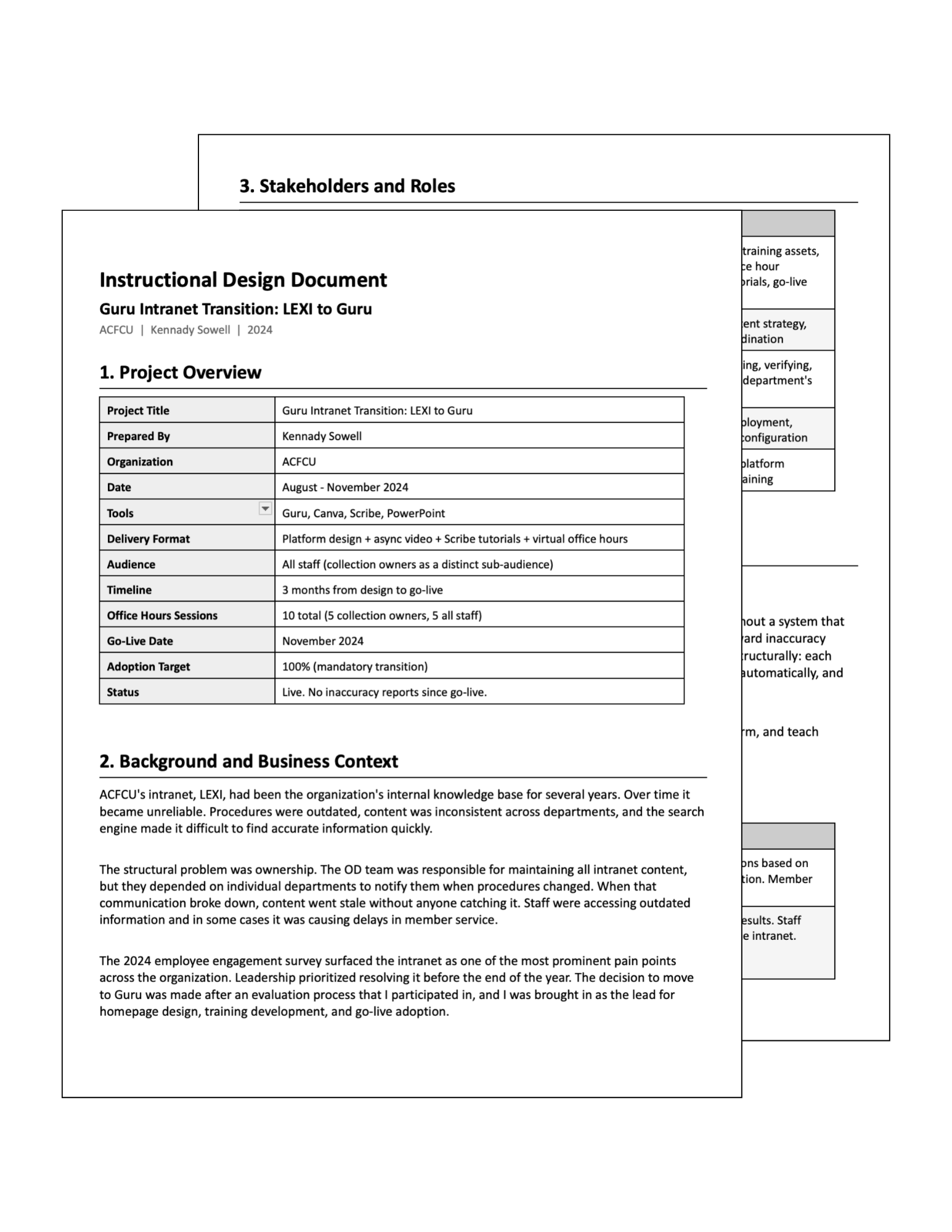
What's inside the design document
This document covers the full transition from LEXI to Guru including the strategic context, my role in platform evaluation, and every training asset built across three months. It includes:
Engagement survey findings that surfaced the intranet as an organizational priority
Platform evaluation notes from pre-decision stakeholder meetings
Homepage design decisions and what each section was built to solve
Full asset inventory including the pre-launch commercial, instructional videos, Scribe tutorials, and office hour sessions
Collection owner training strategy and why the ownership model required a different approach than all-staff training
Adoption plan including the parallel running period and go-live strategy
Evaluation data including search satisfaction ratings and zero inaccuracy reports since November 2024
-
LEXI, the organization's knowledge base, had been a pain point for a long time. Articles were outdated, information was inconsistent, and the search required exact keyword matches, so nothing surfaced unless you already knew what to type. The deeper issue was structural: the OD team owned the knowledge base, but they depended on every department to tell them when procedures changed. When that communication broke down, information went stale and staff made decisions based on outdated content. The 2024 employee engagement survey made it official. Knowledge base quality was one of the most prominent pain points across the organization.
-
Before the organization committed to Guru, I was brought into early evaluation meetings, including conversations with their sales team, to weigh in on whether it would actually solve our problem. I assessed its AI capabilities specifically: retrieval-augmented generation (RAG) search that lets staff ask full questions instead of exact keywords, a collection-based ownership model where each department owns and maintains their own content, and an automated verification system that flags outdated cards and notifies owners on its own. I gave my recommendation to move forward. Once the decision was made, I moved immediately into design and development.
-
The Guru homepage from scratch, which was the most complex piece of the transition. It included a new employee spotlight section, a staff calendar, an incentive goal meter tracking the organization's five performance targets, a volunteer impact meter showing progress toward community goals, a volunteer opportunity board, and quick-access buttons to the ten most commonly used internal tools including Jira, the LMS, and others.
A pre-launch commercial for Guru shown at an all-staff town hall to build excitement before go-live. It was a hit.
Two instructional videos: one for collection owners on how to manage and maintain their collections, and one for all staff on how to search, favorite cards, use the AI search correctly with question marks, and understand the new terminology.
An AI-generated Scribe walkthrough on how to add Guru as a browser extension in Edge and use it without ever navigating to the site directly.
Ten office hour sessions: five for collection owners focused on inputting accurate content before go-live, and five for all staff on using the platform.
-
The homepage alone took significant time because it was pulling together live data, dynamic meters, and multiple content types into a single cohesive experience. The ownership model also required getting every department to take responsibility for their own content, which meant training collection owners not just on the tool but on the mindset of owning their information. The terminology shift from LEXI to Guru was also a real adoption barrier that had to be addressed head on.
-
100% adoption in week 1 and 0 help desk tickets. Switching to Guru was not optional. LEXI ran in parallel for one month during the transition and then went offline. Since go-live in November 2024 there have been no reports of inaccurate information in Guru. Search satisfaction is strong with less than 5% thumbs down ratings on searches. The verification system and automated update notifications to collection owners mean the intranet now maintains itself in a way LEXI never could.
A peak into this initiative…