
Healthcare Customer Support eLearning
A frustrated patient. A new employee. No script. This course changed that.
Freelance Project | Articulate Storyline | Figma Prototype | Gagne's Nine Events | Branching Scenarios | Healthcare Industry
-
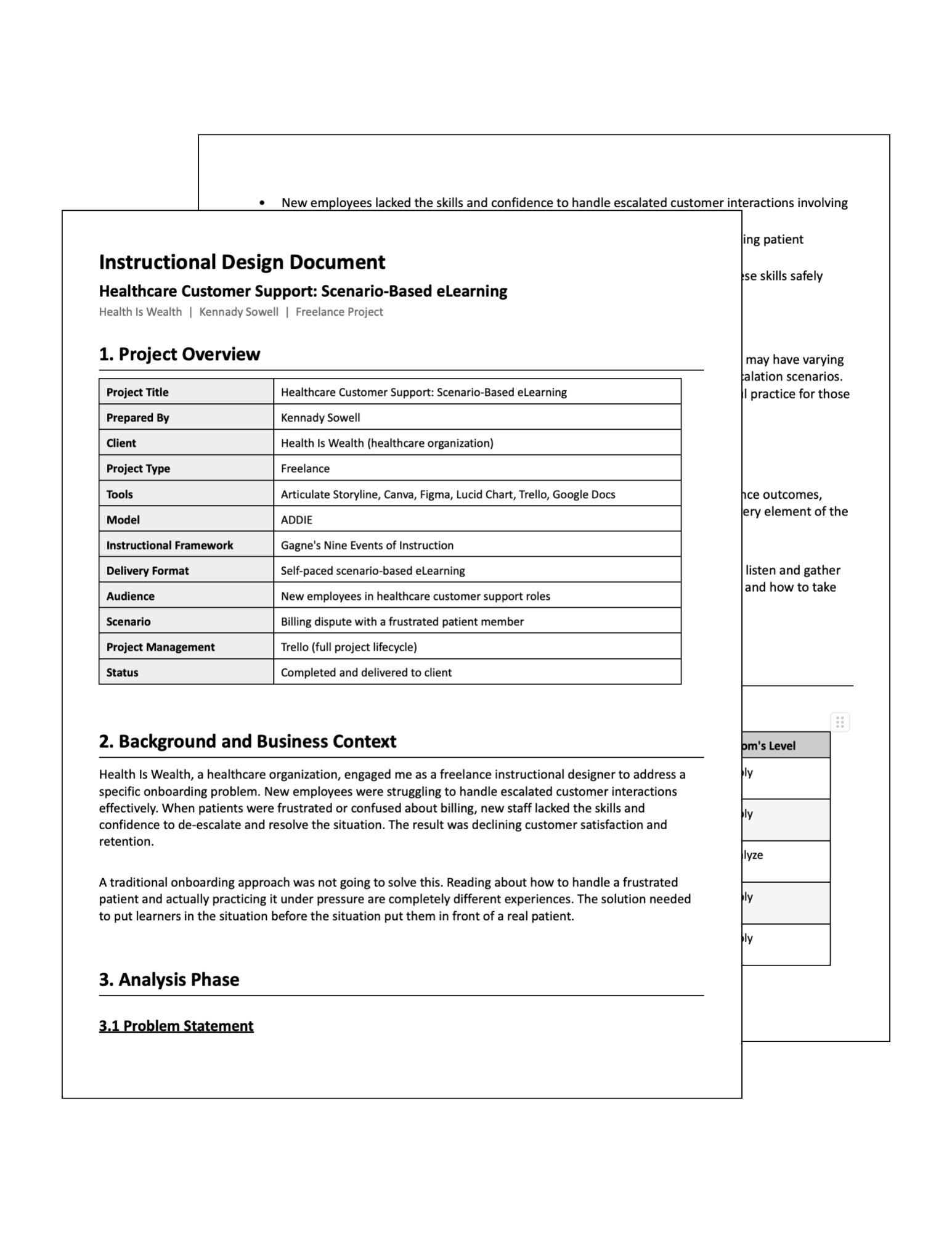
A healthcare organization, was struggling with new employee onboarding specifically around escalated customer interactions. When patients were frustrated, confused about billing, or dissatisfied, new staff did not have the skills or confidence to handle those situations effectively. Customer satisfaction and retention were taking the hit.
-
I conducted a needs analysis and learner analysis in collaboration with subject matter experts and stakeholders. I built an action map in Lucid Chart to identify the exact decision points and performance outcomes before writing a single line of script. I then created a visual prototype in Canva and an interactive clickable prototype in Figma to validate the instructional flow and learner experience before moving into development.
Before the program went live I ran pilot sessions with the COO, CEO, VP of Member Experience, and VP of Employee Experience to pressure-test the content and ensure it aligned with their vision for what leadership at ACFCU should look like. Getting four executives in the room to review a training before it reaches every leader in the organization is not standard practice. It signals how seriously this program was taken and how much trust was placed in the design.
-
A scenario-based eLearning in Articulate Storyline built around Gagne's Nine Events of Instruction. Learners take on the role of Sarah, a customer service representative at MedCare Solutions, and work through a realistic billing dispute interaction with a frustrated member. The course uses branching scenarios so decisions have real consequences. Scripts, dialogues, and all course content were written from scratch. The full project was managed in Trello from analysis through delivery.
-
Three things set this one apart. First the action map came before the script, which meant every decision point in the scenario was grounded in a specific performance outcome, not just a creative choice. Second the Figma prototype was built and validated before development began in Storyline, which reduced rework significantly. Third Gagne's Nine Events provided the instructional framework, meaning the course was not just a scenario but a sequenced learning experience with attention, recall, guidance, feedback, and transfer all deliberately built in.
-
New employees arrived to escalated member interactions with practiced experience rather than theoretical knowledge. The scenario gave them a safe environment to make mistakes, receive feedback, and build confidence before those situations happened in real life.