
Remarkable Service Training
A year in the making. Seven pilots. 20+ videos. One standard the entire organization could finally be held to.
4-Day Program | 7 Pilots to Refine | 20+ Original Videos | 2 Audiences, Every Example Built Twice
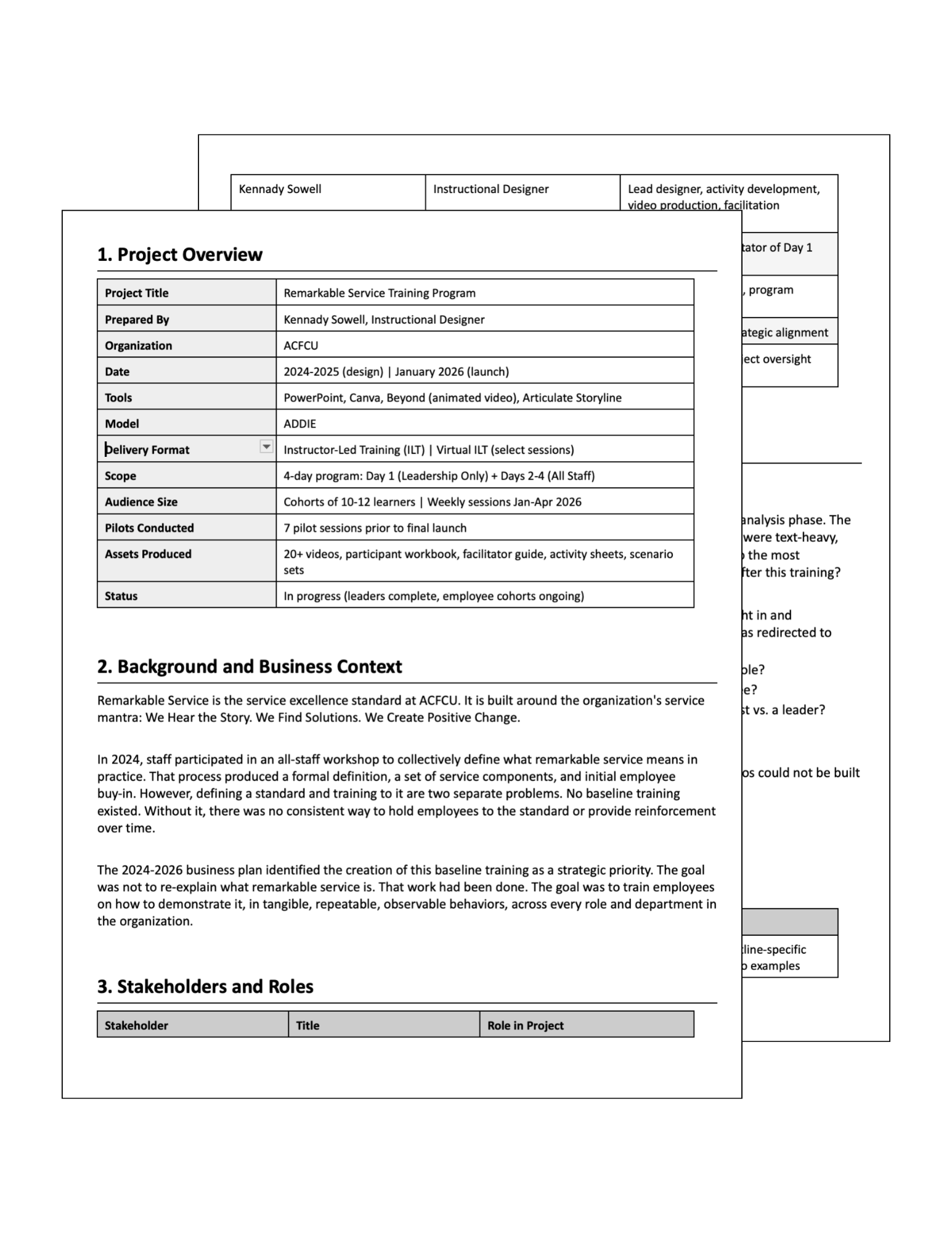
What's inside the design document?
This is the full internal design document created before and during development. It includes:
Stakeholder map across five senior collaborators including the COO and two VPs
Rebuilt learning objectives realigned to Bloom's Taxonomy after the original set was identified as insufficient
Full four-day program structure mapped to the service mantra
Activity design table covering all 13 original activities with the instructional purpose behind each one
Video asset log documenting all 20+ videos by category, audience, and purpose
Seven-pilot iteration log showing what broke, what was fixed, and why
Kirkpatrick evaluation plan across all four levels with notes on current measurement status
-
Remarkable Service was a term the credit union had defined, but defining it and training to it are two different things. Staff had participated in workshops to establish what remarkable service meant to them. The components were identified. The definition was written. But there was no training that answered the most important question: how do you actually do it? That baseline training had never existed. Without it, there was no standard to hold anyone to and no foundation for reinforcement going forward. The 2024 to 2026 business plan made it a priority. This was the program that would build it from scratch.
-
Kennady joined the project about two months in and immediately identified a critical problem: the learning objectives were not Bloom's-aligned, were text-heavy, and did not connect to observable behavior. No one had started with the end in mind. Before a single activity was designed, she pushed the team to answer three questions: What do we want people to walk away knowing how to do? What does remarkable service actually look like in action? What are the repeatable, tangible behaviors we want to see day to day? Once those questions were answered, the design had a foundation.
-
A four-day instructor-led training program built around the credit union's service mantra: We Hear the Story, We Find Solutions, We Create Positive Change. Each day maps to one part of the mantra. Every activity was designed to simulate the how, not rehash the what and why, which had already been covered in earlier all-staff workshops. Day 1 is leadership-only, facilitated by the VP of Member Experience. It covers leadership attributes, rewards and recognition, and effective coaching. Days 2 through 4 are for all staff and include role plays, gallery walks, scenario-based animated videos, a workplace mystery activity for critical thinking, an $86,400 seconds time management exercise, and a nonverbal communication activity where learners line up in birthday order without speaking. Every session includes a participant workbook and facilitator guide. Altogether the program included 20+ original videos, custom activity sheets, printed participant workbooks, scenario sets for both frontline and back office audiences, and a full facilitator guide. Seven pilot sessions were run before the final version was locked, each one used to refine activities, tighten timing, and pressure-test the content against real learners.
-
Building real examples for every component for both frontline and back office employees. Accounting, lending, marketing, business intelligence, and the contact center all needed their own scenarios. Getting accurate, realistic examples from each department took significant time and coordination across multiple stakeholders including the VP of Member Experience, VP of Employee Experience, and the COO.
-
This was a year-long initiative. Seven pilots. 20+ videos produced. Cohorts of 10 to 12 running weekly from January 2026 through April. All leaders have completed the full four-day program. A 50% survey response rate on an anonymous voluntary survey three months in is strong signal. Town hall feedback has been consistently positive, with the CEO publicly praising the program. A companion quality monitoring training was also developed for the new scoring system covering both frontline and back office, though implementation was paused due to a pending merger.